The Tower is the card people remember even when they forget half the deck. Lightning. Falling bodies. A crown knocked loose. It looks like the moment after the phone rings and your face changes before you have words. It looks like an inbox subject line that makes your stomach drop. It looks like the cracked mug on the floor because your hand was shaking and you were trying very hard to act normal.
I do not read The Tower as punishment. I read it as the part of life where the false wall gives way. Sometimes the collapse is loud: a breakup, a firing, a confession, a bill you cannot pretend away. Sometimes it is quiet. You hear one sentence and suddenly the story you have been living inside no longer holds. You still make coffee. You still answer a text. But something has split open.
Before reading The Tower, stay with the image for a little longer than feels efficient. What is bright? What is hidden? Who is exposed? Who is moving, frozen, relieved, ashamed, or pretending not to care? Beginners often run straight to a keyword list because a quick answer feels safer. I understand that. Still, the picture usually gives you the temperature of the reading before the textbook meaning does.
The spread position matters. In the past position, The Tower may describe what shaped the situation. In the present position, it is the room you are standing in now. In advice, it becomes a behavior. In the obstacle position, it may show avoidance, exaggeration, delay, or a lesson being used the wrong way. Same card, different job. This is where a reading stops being memorization.
In love readings, The Tower can show a revelation, a sudden argument, the end of denial, or the moment when a relationship can no longer survive on vague promises. It may be a breakup, yes. It may also be the fight that finally names the thing both people have been stepping around.
When the question is about another person, do not let the card make you reckless. Tarot can suggest a pattern, a mood, a likely pressure, or a possible next move. It cannot give you legal access to someone's private mind. That distinction matters most in love readings, where people are often tired, hungry for certainty, and ready to believe the sentence that hurts less.
In career and money readings, The Tower can be layoffs, failed plans, public mistakes, broken systems, urgent repairs, or the discovery that a job was built on exhaustion and polite silence. The card asks what was unstable before it fell. That question is less dramatic, but usually more useful.
Career readings need ordinary details or they become decorative. Ask what The Tower would change on a Tuesday morning. Would someone send the email, read the contract, ask for the number, stop overexplaining, take the meeting, decline the meeting, document the conversation, or finally admit the schedule is impossible? If the meaning cannot touch a calendar, it may not be ready yet.
Reversed, The Tower can show a delayed collapse, private panic, a crisis that has not fully reached the surface, or the attempt to keep decorating a structure that needs inspection. Sometimes reversed Tower is the person saying, everything is fine, while closing thirty browser tabs with a red face.
Do not treat the reversal as a toy opposite. Reversed can mean blocked, delayed, private, excessive, denied, internalized, or beginning to loosen. Sometimes it is the same message, but quieter. Sometimes it is the truth showing up sideways because a person has not found a clean way to say it.
As advice, The Tower is not telling you to smash your life for effect. It asks you to stop protecting the lie. Open the bill. Ask the direct question. Save the document. Leave the room if it is unsafe. Call the person who can help you see what is actually standing.
A small spread works well with this card: one card for what is true, one for what I am adding from fear, and one for the next honest action. Keep it modest. A huge spread can feel productive while it quietly helps you avoid the one sentence you already heard.
Ask the cards to speak in plain language. No grand phrase for a minute. No polished spiritual vocabulary. Say what a person would actually do. They open the envelope. They stop refreshing the chat. They ask for the deadline. They admit they are tired. They sleep before replying. Plain language is not less mystical. Often it is the only language that can be used the next morning.
For yes-or-no readings, I would not force The Tower into a stamp unless the whole spread was built for that. The answer often has conditions. Yes, if the pattern changes. No, if everyone keeps performing calm. Not yet, because the facts are still moving. A good reading tells you what would make the answer change.
Card combinations help when you let the cards disagree. If The Tower appears with The Devil, look for attachment, compulsion, shame, or pressure. With Temperance, ask what needs pacing and repair. With Justice, bring the reading back to facts, consequences, and accountability.
Do not mash meanings together until they become fog. Let one card be warm and another severe. Let one card want speed while another asks for proof. Real life is like that. A person can love you and still avoid the truth. A job can be promising and badly managed. Hope can be real and still need a plan.
Keep a tarot journal, but make it useful. Write the question, the card, your first interpretation, your mood, and what happened later. The mood matters. A reading done after three coffees and no breakfast is not the same as a reading done after a walk and a sandwich. I wish this were less obvious. It is not.
The journal will show your habits. Maybe you soften every difficult card because you hate disappointing people. Maybe you turn every unclear card into disaster because anxiety feels like preparation. Maybe you read your own love questions like a lawyer trying to protect a guilty client. Seeing the pattern in ink is uncomfortable. That is why it helps.
Try reading The Tower for three ordinary people. One is waiting for a text. One is deciding whether to stay in a job. One is embarrassed about money. Give each person a different interpretation. This keeps the card alive. It stops you from handing every human being the same memorized paragraph.
Tone matters. The Tower may need a firm voice, a gentle one, or a dry little sentence that refuses to make the situation more dramatic than it is. The goal is not to sound gifted. The goal is to be useful without making the person feel smaller.
When you read for yourself, notice the bargaining. You pull the card, feel the first honest hit, then start negotiating. Maybe it means them, not me. Maybe I should pull one more. Maybe the deck is tired. Sometimes that is intuition. Sometimes it is avoidance wearing a velvet coat. You learn the difference slowly, and not always gracefully.
A clarifier needs a job before you draw it. Clarify the obstacle. Clarify the next step. Clarify what I am projecting. Clarify what behavior would prove change. If you do not name the job first, the clarifier becomes another thing to manage. That is how a simple reading turns into a crowded table and a headache.
Notice the body. The stomach, jaw, throat, shoulders, and hands often react before the mind has arranged its explanation. This does not make every sensation prophecy. It means the body is in the room with the cards, especially when the question touches love, money, status, grief, or fear.
If you are reading for a friend, leave room for correction. Say, this is what I am seeing; does it land anywhere? That question is not weak. Your friend has the lived context. You have the cards. The reading is a conversation, not a performance of certainty.
If they say no, do not fight for your interpretation. Maybe you missed. Maybe the language was wrong. Maybe the card points to something they cannot talk about yet. Stay curious. A reader who can adjust is much easier to trust than a reader who needs to win.
The book I would keep nearby for this lesson is Tarot for Beginners, listed on Books. A book cannot replace practice, but it can keep you from turning every card into either a blessing or a disaster when you are still learning the deck's weather.
After the reading, write two sentences. First: what did the card make clearer? Second: what still feels unresolved? Let the second sentence stay unresolved if it needs to. Not every reading deserves a bow tied around it. Some readings only open the honest question.
Before you close the spread, name the least glamorous next step. Not the lesson. Not the beautiful insight. The step. Send the plain email. Wash the cup. Check the date. Stop drafting the clever reply. Put the cards away and call the person directly. Tarot becomes stronger when it can survive boring instructions.
I like asking what this card looks like at 8:30 on a Tuesday morning. That question saves readings from floating away. It brings the meaning back to shoes by the door, cold coffee, a bank app, a car that needs gas, a child asking where the blue shirt is, a person rereading one sentence from last night.
For timing, stay modest. The Tower may show a phase more than a date. Look at nearby suits, spread position, and real-life constraints. A legal answer, a job offer, a reconciliation, a recovery, or a family decision all move at different speeds. Tarot can show the weather. Life still owns the calendar.
At some point, this card will not mean what you wanted. That is not a failure of tarot. That may be the moment tarot starts working. A reading that only confirms the preferred story is pleasant. A reading that makes you sit quietly for five minutes may be more useful.
So when The Tower appears, do not rush to make it grand. Look at the image. Look at the position. Look at the actual question. Ask what behavior would respect the message and what fantasy would misuse it. Then say the clearest sentence you can without pretending to know more than you do.
That is enough for one reading. Really. You do not need to solve the whole life. Let the card name the next honest thing. Sometimes it is a conversation. Sometimes it is a pause. Sometimes it is an ending. Sometimes it is lunch, sleep, and reading the document again with a steadier hand.
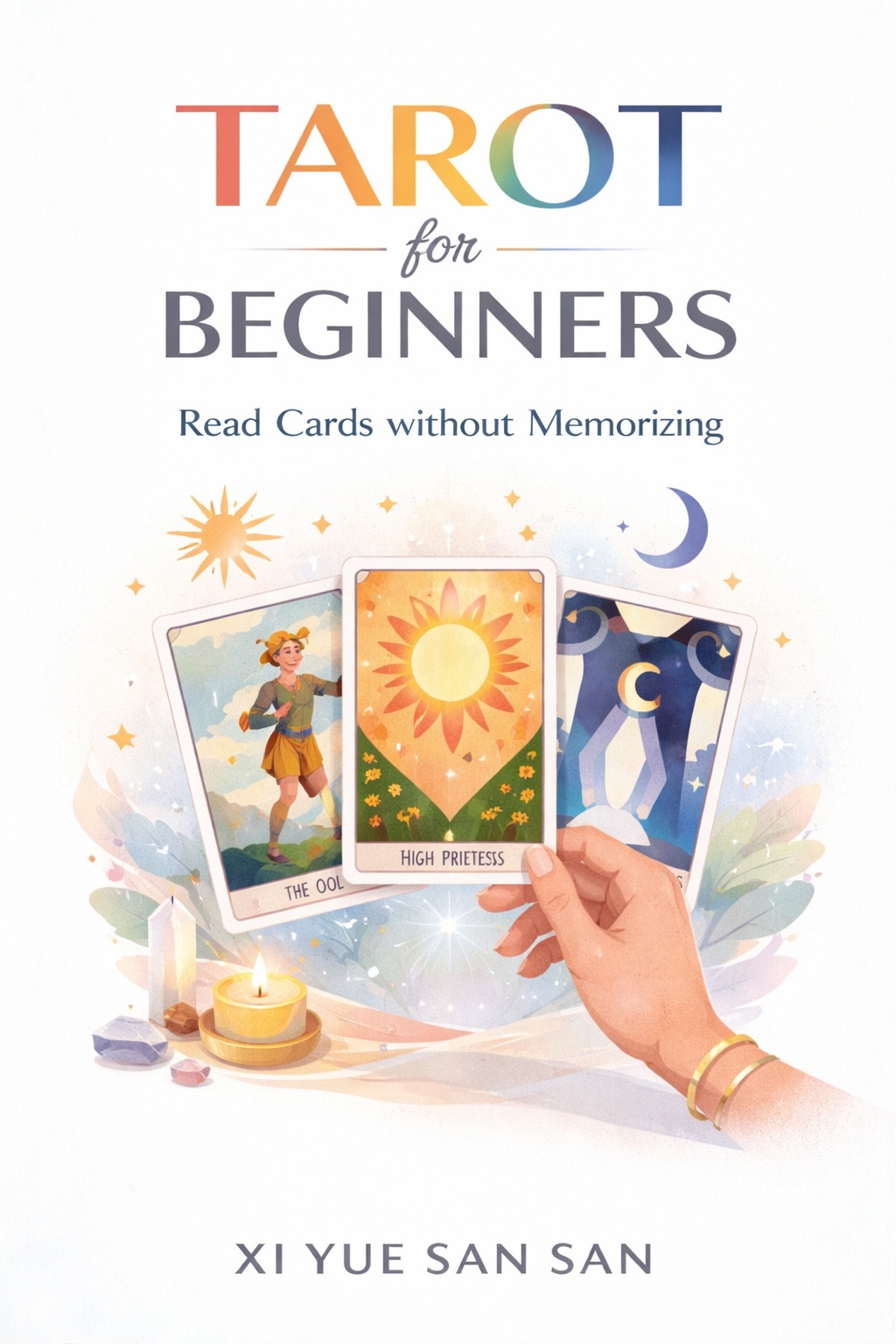
Book recommendation
Tarot for Beginners is a gentle companion for learning card meanings without turning the whole practice into memorization homework.
Open the book page