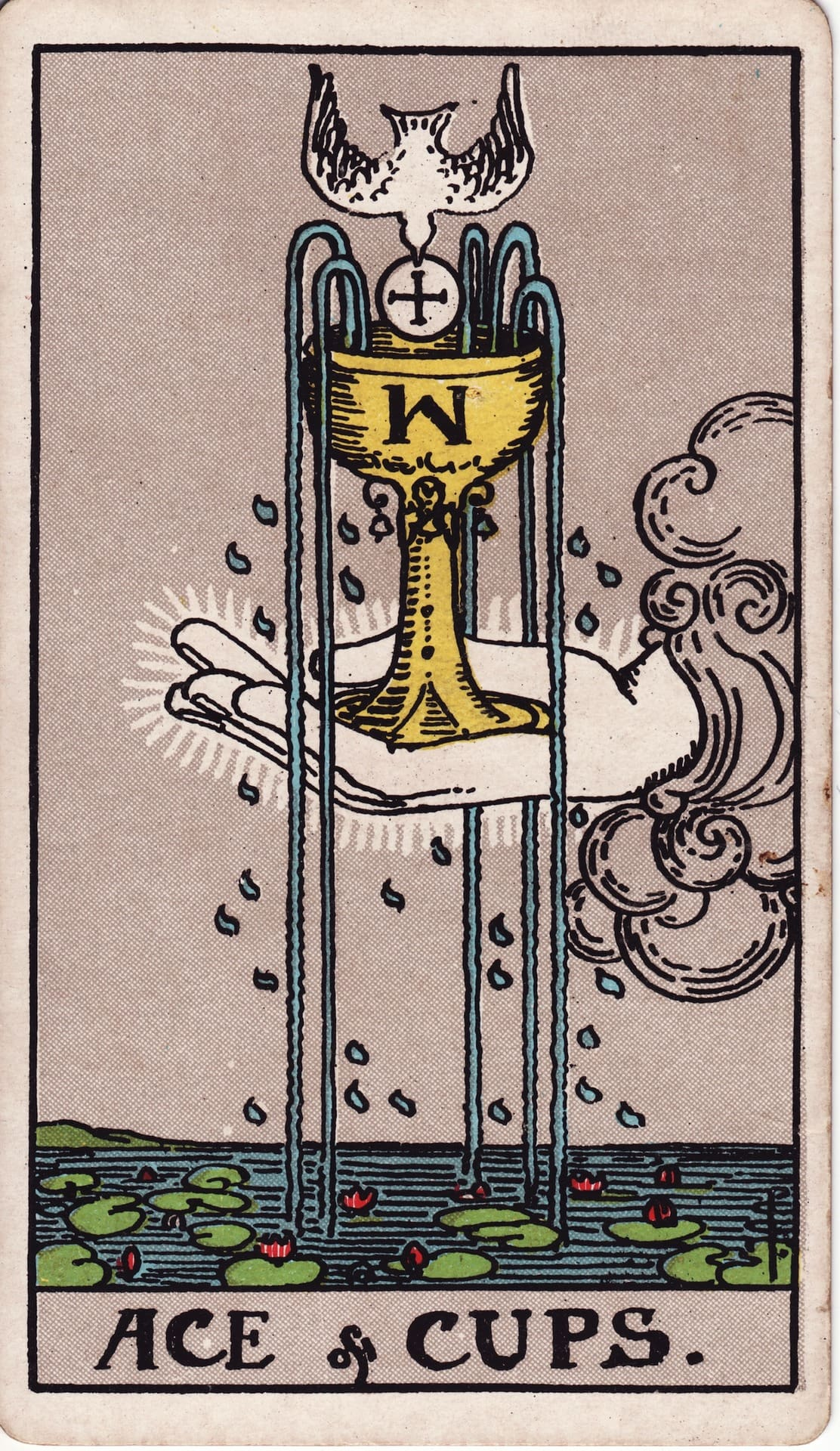
Ace of Cups — semantic depth: love, timing, shadow & lived nuance
Below is a slower, more human read of Ace of Cups—written for people who already know the keywords (new feelings, spirituality, intuition, love, inner voice) and want language that can hold a real relationship: awkward repair, quiet breakups, timing that stings, and the shadow that shows up when we are tired.
Relationship dynamics
When Ace of Cups lands in a “relationship dynamics” position, try reading it as role energy rather than “what they are.” Two people can love each other and still get trapped in loops shaped by new feelings, spirituality, and intuition. As a Cups card, Ace of Cups often speaks in a watery, intimate, memory-heavy dialect: less “prediction,” more “how desire, fear, and habit move through bodies and calendars.” Ask: who is carrying the emotional labor here? Who gets to be confused out loud? Who is punished for having needs?
A practical frame: picture the last disagreement you had—not the facts, but the temperature. Ace of Cups often mirrors that temperature: where voices went thin, where someone went silent to stay safe, where tenderness tried to return and got misread as pressure. If you pair Ace of Cups with a court card, read the court as a person’s coping style; if you pair it with a number card, read the number as how long this pattern has been rehearsed.
If you are reading for a situationship, Ace of Cups can name the paradox beautifully: closeness without clarity, intimacy without commitment, sweetness that still spikes anxiety. That doesn’t automatically mean “leave.” It can mean: name the story you are living inside, then choose one boundary that makes the story honest—whether you stay or go.
Dynamics also include power: who apologizes first, who earns forgiveness, who is allowed to be angry. Ace of Cups can highlight love as a hinge where fairness wobbles. A compassionate reading names power without turning anyone into a villain caricature—people are uneven, scared, and still capable of repair.
Emotional interpretation
Emotionally, Ace of Cups is less a verdict and more a weather report. People rarely feel one thing; they feel a stack—shame under anger, relief under grief, hope braided with dread. Keywords like new feelings and spirituality are not labels to slap on someone; they are invitations to ask, “What would a human have to believe about themselves to behave this way?”
If you are reading for yourself, Ace of Cups can be embarrassingly accurate about the small ways you protect your heart: the joke you make too quickly, the text you draft and delete, the softness you postpone until “later.” Emotional interpretation here is not softness for its own sake—it is precision. It helps you separate sensation from story: “My chest is tight” is not the same sentence as “They never loved me.”
When Ace of Cups appears reversed in feelings spreads, I read it gently: same river, rougher banks—internalization, delay, shame, or overstimulation. Reversed doesn’t have to mean “bad.” Sometimes it means you are finally feeling something you postponed for years, and your nervous system is doing the work in real time.
Let Ace of Cups teach emotional vocabulary. Instead of “I’m fine,” try “I’m braced.” Instead of “They’re toxic,” try “I feel unsafe here, and I need a plan.” The card’s themes (new feelings, spirituality, intuition, love, inner voice) become a phrasebook for honesty without cruelty.
Reconciliation
Reconciliation questions are tender. Ace of Cups can suggest repair is possible when both people can tolerate nuance—when “sorry” includes changed behavior, not just relief. Look for intuition as a bridge: what would repair require you to admit? What would it require you to stop bargaining away?
If reconciliation is the hope, let Ace of Cups warn you against rushed closure. True repair often looks boring: calendars, boundaries, awkward check-ins, therapy, or simply slowing down enough to hear what the other person means—not what you fear they mean. Ace of Cups can bless that slow road as sacred, not insufficient.
Sometimes Ace of Cups says reconciliation begins inside one person: you return to yourself first—your values, your body, your sleep—and the relationship changes because you are no longer abandoning yourself to keep the peace.
If reconciliation is not possible, Ace of Cups can still offer dignity: you can grieve without groveling, miss someone without rewriting your boundaries, and love the past without volunteering for the same wound again.
Breakup energy
Breakup energy is not melodrama; it is logistics of the heart. Ace of Cups can describe the chapter where love still exists but fit does not—where values diverge, where growth pulls in different directions, or where trust can’t be rebuilt without a miracle and a calendar. Keywords like love may show up as the honest reason the bond thins, even if nobody says it out loud.
If you are leaving, Ace of Cups can validate grief without guilt: you can honor what was beautiful and still choose a future where you do not shrink. If you are being left, Ace of Cups can be a hand on the shoulder: your dignity is allowed to exist alongside your longing. You can miss someone and still refuse to negotiate your worth down to a manageable size.
In spreads, pair Ace of Cups with cards that name resources: friends, money, housing, therapy, creative work. Breakups are not only emotional events; they are embodied. Ace of Cups reminds you that healing is not a vibe—it is meals, boundaries, and sleep.
Breakup energy can also be relief—guilty relief. Ace of Cups can normalize that too: you are not cruel for feeling air in your lungs when a painful cycle ends. You are human.
Timing
Timing is the rudest question tarot gets—because life is co-created, not scheduled like a dentist appointment. Still, Ace of Cups can speak to pace: seasons when spirituality accelerates, seasons when it needs rest. Think in weeks and chapters, not minutes and guarantees.
A grounded timing practice: ask the deck for “what moves first internally,” then “what moves first externally.” Ace of Cups might describe the internal shift (clarity, anger, hope) while another card describes the outer event (conversation, travel, a letter). That separation reduces panic and keeps you from waiting for the universe to do the parts only you can do.
If Ace of Cups shows up with a lot of swords, timing may hinge on a conversation you keep postponing. If it shows up with pentacles, timing may hinge on money rhythms, work schedules, or health. If it shows up with cups, timing may hinge on emotional safety—when trust returns enough to try again.
Use Ace of Cups as a calendar question only if you also ask what you will do while you wait. Waiting without agency breeds obsession; waiting with care breeds steadiness.
Shadow meaning
Shadow is not “evil.” Shadow is what you do when you are scared—control, avoidance, people-pleasing, contempt, numbing. Ace of Cups can illuminate a shadow flavor tied to inner voice: the part of you that would rather be right than be connected, or the part of you that confuses intensity for intimacy.
If this shadow reading stings, breathe. The point is not self-attack; it is self-clarity. Ace of Cups can help you ask, “Where am I borrowing identity from pain?” and “What would accountability look like if it still felt kind?” Shadow work in tarot should leave you more human, not more ashamed.
Reversed Ace of Cups sometimes intensifies shadow themes—especially when someone is over-functioning, under-communicating, or using spirituality to bypass real harm. If that resonates, treat the card as a boundary, not a sentence: you are allowed to seek real-world support.
Shadow can also live in the reader: the temptation to be dramatic, certain, or special. Ace of Cups invites humility: hold the mystery, but don’t inflate it into authority over someone else’s life.
Examples (short vignettes)
Example A: Ace of Cups appears after a late-night kitchen talk. The question isn’t only “Will they stay?” It’s whether both people can say what they mean without punishing the other for listening. Ace of Cups highlights new feelings as the emotional truth trying to get spoken.
Example B: Ace of Cups appears while you’re navigating two exes circling a friendship. Here, Ace of Cups can describe the mixed weather—tenderness with fear, hope with fatigue—and invite one small practice: a boundary, a pause, a request for clarity, or a decision to stop guessing.
Example C: Ace of Cups appears when someone is carrying shame alone. The spread isn’t asking you to be perfect; it’s asking you to be reachable—by a friend, a therapist, or your own future self. spirituality becomes the bridge from isolation to contact.
Example D: Ace of Cups appears when a couple keeps “starting over” without new behavior. The card can name hope as habit—and gently ask what evidence supports a different outcome this time. Evidence is not cynicism; it is love for reality.
Nuanced interpretations
Nuance is the difference between a reading that sounds like a horoscope and a reading that sounds like a mirror. Ace of Cups is rarely “only” romantic, “only” career, or “only” spiritual. Human life leaks categories: money stress becomes irritability in love; creative blocks become bodily fatigue. Ace of Cups asks you to read the whole ecosystem.
Try reading Ace of Cups through three lenses—want, fear, and strategy—even if your spread doesn’t label them. Want: what is hungry? Fear: what is bracing? Strategy: what is the next kind step that doesn’t lie? If you can name all three, the card stops being a slogan and becomes a conversation.
Upright Ace of Cups often emphasizes the constructive face of the keywords; reversed can emphasize their distortion—same need, different coping. But life is messy: sometimes “upright” behavior is avoidance dressed nicely, and sometimes “reversed” behavior is survival. Context cards are not optional decoration; they are grammar.
If two meanings fight, write both down. Ace of Cups can tolerate paradox better than panic can. Let paradox be a door: “I want closeness” and “I want safety” can both be true; the work is sequencing and boundaries.
Practical advice
Practical advice is where tarot becomes kind. For Ace of Cups, consider one action in the next seven days that honors intuition without forcing an outcome: a boundary sentence you practice aloud, a walk without your phone, a therapy appointment, a financial truth you finally look at, or a love note that includes what you need—not only what you adore.
If you read for someone else, practical advice might mean helping them translate symbols into choices: “This card doesn’t say you’re foolish; it says you’re overstimulated. What would soothe your nervous system enough to choose cleanly?” Ace of Cups supports empowerment readings that still respect mystery.
If you are stuck in decision fatigue, let Ace of Cups shrink the question. Not “What will happen forever?” but “What would integrity look like tomorrow morning?” Tarot answers smaller questions more honestly—and smaller answers often unlock the big ones.
Advice can be tiny: drink water, sleep before you text, ask one clarifying question instead of assuming. Ace of Cups blesses small repairs; small repairs stack.
Emotional phrasing & a living voice
Sometimes the most accurate reading sounds like plain speech: “You’re tired.” “You’re proud.” “You’re lonely and you don’t want to be dramatic about it.” Ace of Cups can hold those plain truths without turning them into a personality attack. Emotional phrasing is a skill: describe feelings as weather patterns, not as verdicts on character.
Unique wording doesn’t mean “fancy.” It means specific. Instead of repeating new feelings, spirituality, intuition, love, inner voice like a chant, describe what they feel like in a body: heat in the face, a softer jaw, the urge to apologize too fast, the urge to disappear. Ace of Cups becomes memorable when the reader risks a little humanity.
If you journal with Ace of Cups, try writing a letter you won’t send—two paragraphs to yourself, one paragraph to the other person’s humanity (even if you’re angry). Tarot is a ritual for language. Ace of Cups is a doorway: walk through it, and let your sentences be imperfect but true.
Voice also means rhythm: short sentences when someone is overwhelmed; longer sentences when someone needs companionship in thought. Ace of Cups can guide your cadence as a reader—match the sitter’s nervous system, then offer one clear next step.
How this card walks through a week (micro-timeline)
Monday to Wednesday with Ace of Cups might show up as subtle signals—dreams, “coincidences,” old memories resurfacing. Thursday to Friday might bring a choice point: speak or swallow, act or rest. The weekend might ask for integration: what did you learn, and how will you treat yourself while you learn it? This micro-timeline is illustrative, not prophetic; it is a tool for noticing.
If Ace of Cups is your “theme of the week,” track where spirituality appears in tiny decisions: what you buy, what you scroll, who you text first, what you avoid cleaning. Meaning hides in mundane repetitions. Tarot becomes deep when you let it be ordinary.
If nothing dramatic happens, that is not failure. Ace of Cups can work underground—like roots—until a later week when language finally arrives.
Closing notes for ethical readers
Ace of Cups can open big doors. If your sitter is in danger—coercion, violence, severe mental health crisis—cards cannot replace hotlines, medical care, or legal help. The deepest “human feeling” a reader can offer is sometimes a gentle interruption: “You deserve safety first.” Tarot can companion that truth; it should not compete with it.
Return to the
tarot card meanings hub when you want a lighter map of all 78 cards. Return to Ace of Cups when you want a slower conversation—one that honors love as practice, timing as humility, and shadow as something you can hold without flinching.